Patient Protection Guide
How to Choose the Right Implant Provider - A Guide for Memphis Area Patients
The single most important factor in your implant outcome is the specialist performing the procedure. Here is exactly what to evaluate, what to ask, and what the answers should tell you - before you commit.

Dr. Pradeep Adatrow
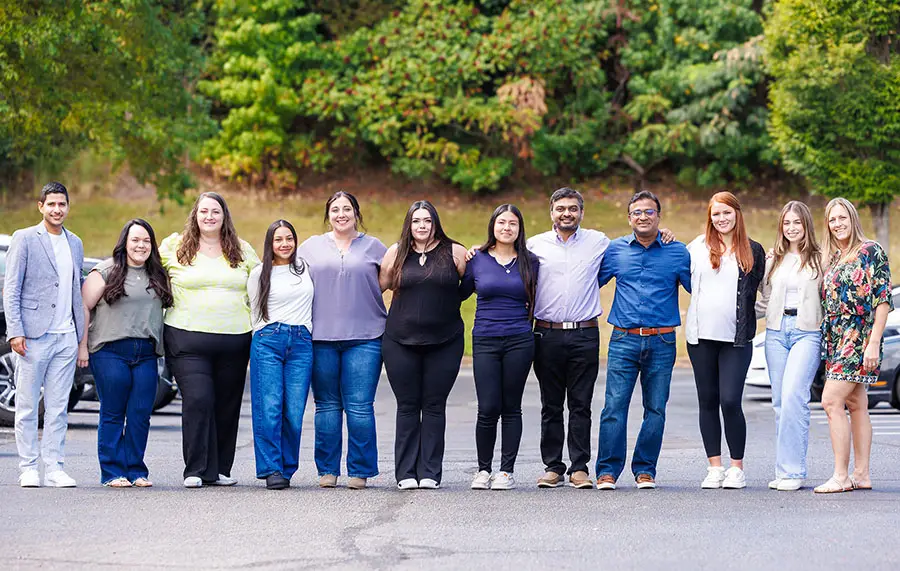
Dr. Adatrow - With the Care Team
Why Provider Selection Is the Most Important Decision You Will Make
Dental implants are surgical procedures. The titanium post is placed inside your jawbone - near nerves, sinuses, and critical anatomy. The prosthetic restoration must fit precisely, function correctly, and integrate with your bite, your existing teeth, and your aesthetics. A mistake in either domain - surgical or restorative - is not easily corrected. Some errors are irreversible.
The implant success rate in experienced specialist hands is over 95% at 10 years. In less experienced hands, or with inadequate technology, that rate is meaningfully lower. The difference between these outcomes is the provider. Here is what to evaluate.
1. Board Certification - The Baseline Standard
Look for a Diplomate of the American Board of Periodontology or the American Board of Prosthodontics. These are the two dental specialties with the most rigorous implant training. Periodontists complete 3 additional years of hospital-based surgical residency focused on bone, soft tissue, and surgical management. Prosthodontists complete 3 additional years focused entirely on complex restoration and replacement of teeth.
General dentists can legally place implants in most states - but they lack the depth of specialty training in either the surgical or restorative domain. For simple single-tooth cases in ideal bone, this may be adequate. For complex cases - full arch, significant bone loss, previous implant failures - specialist-level training is not optional.
Rarest and most valuable: dual board certification in both specialties. This means a single provider has the surgical expertise of a periodontist AND the restorative expertise of a prosthodontist. Dr. Adatrow holds both certifications - one of very few practitioners nationally to do so.
2. Case Volume & Complexity Experience
Ask specifically: "How many implant cases do you complete per year?" and "What percentage of your practice is implant-focused?" A high-volume implant specialist has encountered - and solved - a far wider range of anatomical challenges, complications, and edge cases than a lower-volume provider. Implant dentistry rewards experience in ways that are directly measurable in outcomes.
Also ask: "Do you perform All-on-4 / full-arch cases?" This is the most technically demanding category of implant procedure. A specialist who performs it regularly has skills that apply broadly to all implant cases. A provider who does not perform it may not be equipped for complex single-arch scenarios either.
3. Technology - Non-Negotiables for 2024
CBCT 3D Imaging: Any specialist placing implants should use cone beam CT scanning. Two-dimensional X-rays cannot reveal bone volume in three dimensions, cannot reliably map nerve locations, and cannot support accurate surgical planning. If a provider is planning implants without CBCT, that is a significant red flag.
Surgical Guides: Computer-generated surgical guides derived from 3D imaging allow the drill to be physically directed to the planned position - eliminating freehand error. For complex cases, guided surgery should be standard, not optional.
Photogrammetry (for full-arch cases): If you are having All-on-4 or any full-arch reconstruction, ask specifically: "Do you use photogrammetry to capture implant positions for the final bridge?" If the answer is no, ask what they use instead and research the accuracy implications.
4. In-House Capability
Some practices refer the surgical component to an outside oral surgeon, then fabricate the final restoration with yet another provider. While this fragmented model can work, it introduces coordination risk, communication gaps, and potential for misalignment between surgical planning and prosthetic goals.
An in-house specialist - particularly one with dual specialty training - manages the entire care continuum. The surgical plan is designed with the final restoration in mind from day one. There is no handoff, no interpretation loss, no gap between what the surgeon does and what the restorer needs.
5. Sedation Options
Complex implant surgery should not be performed with the patient uncomfortable, anxious, or requiring constant breaks. Ask whether IV sedation is available - and whether it is performed in-office or requires a hospital setting. In-office IV sedation is significantly more accessible, more convenient, and substantially less expensive than hospital-based anesthesia.
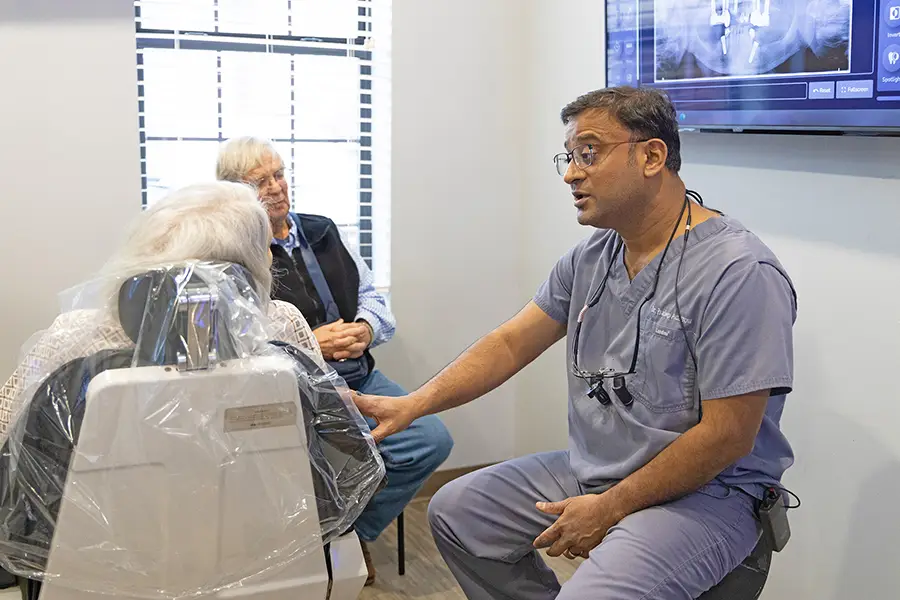
Consultation in Progress
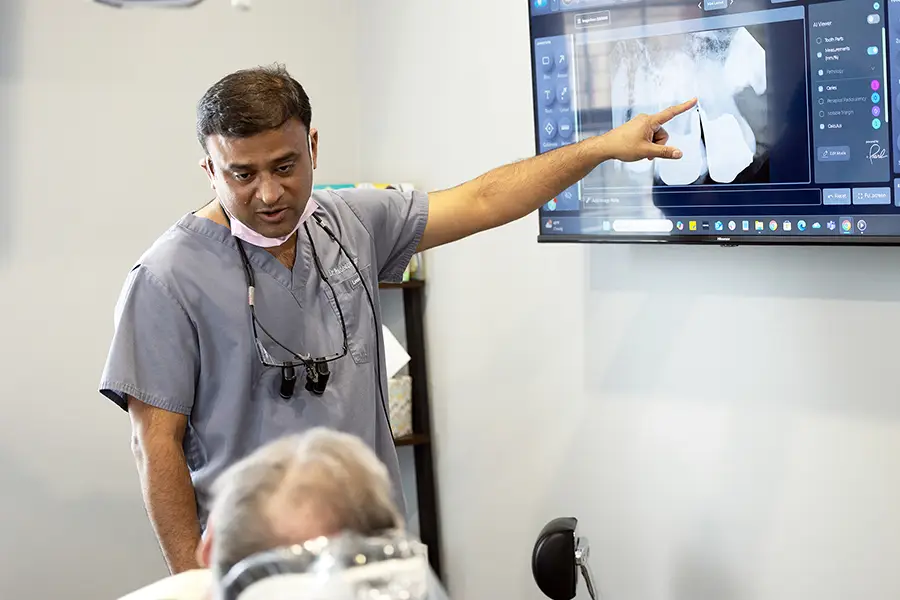
3D CBCT Images on Screen
6. Cost Transparency
A trustworthy provider will present a comprehensive, itemized treatment plan before you commit — including the cost of implants, extractions (if needed), bone grafting (if needed), provisional restorations, final restoration materials, and follow-up care. Beware of unusually low entry-point pricing that doesn't reflect the full scope of treatment. The question to ask is: "What is the all-in cost, including everything I might need?"
Questions to Ask at Your Consultation
Six Questions Every Patient Should Ask
- "Are you board-certified, and in which specialty?" (Look for Periodontology and/or Prosthodontics)
- "How many implant cases do you perform each year, and what percentage involve full-arch reconstruction?"
- "Do you use CBCT 3D imaging and computer-guided surgical guides for planning?"
- "For full-arch cases: do you use photogrammetry to capture implant positions?"
- "Is IV sedation available in-office, or would I need to go to a hospital?"
- "Can you provide a fully itemized cost estimate for everything my treatment will require?"
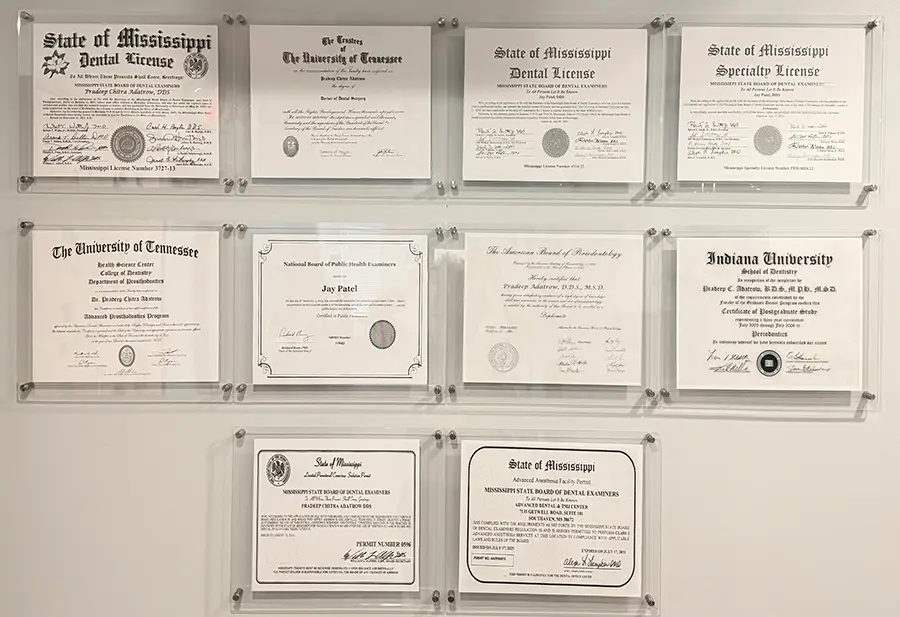
Board Certification Documents / Diplomas
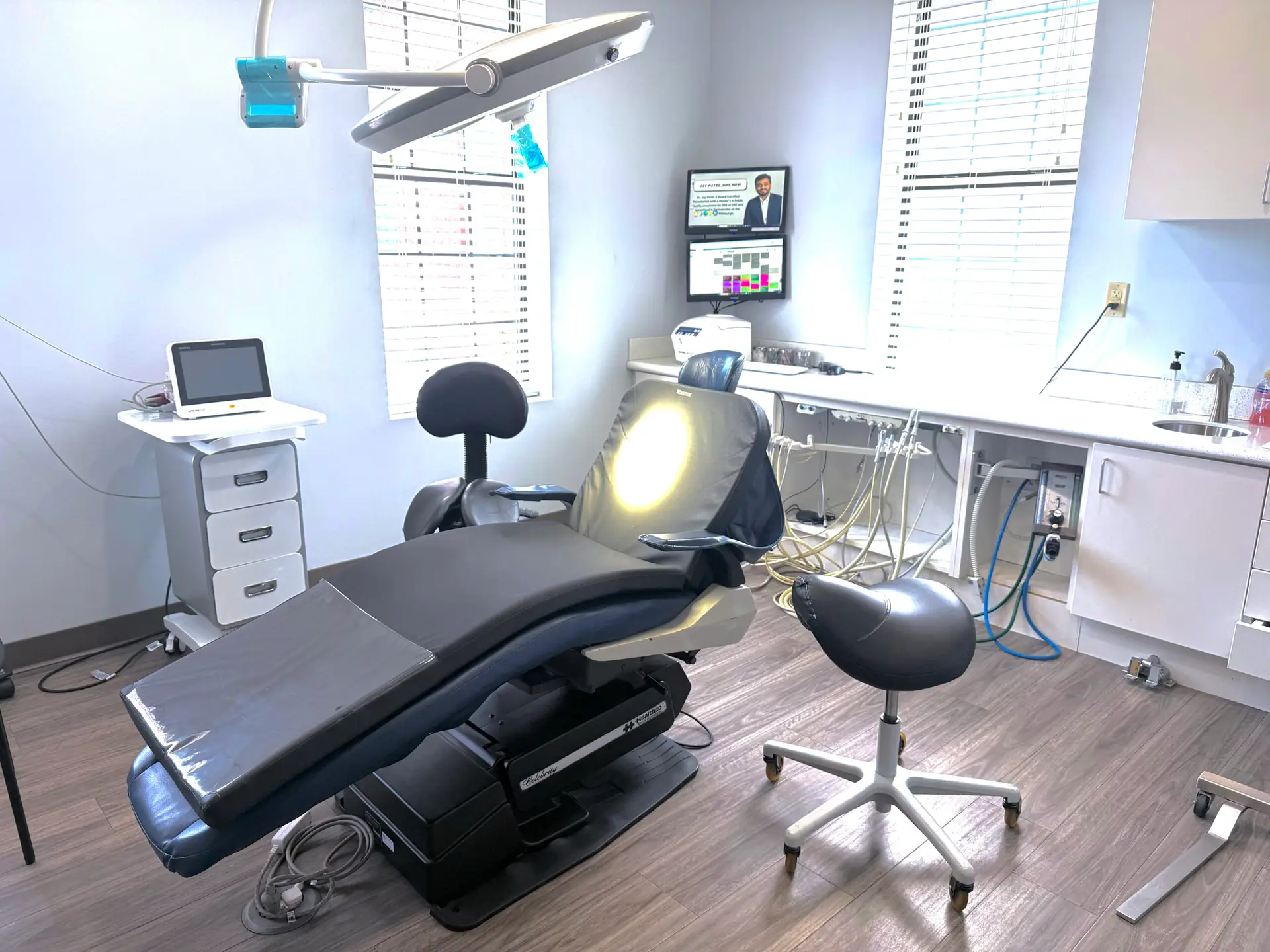
Practice Interior - Treatment Room
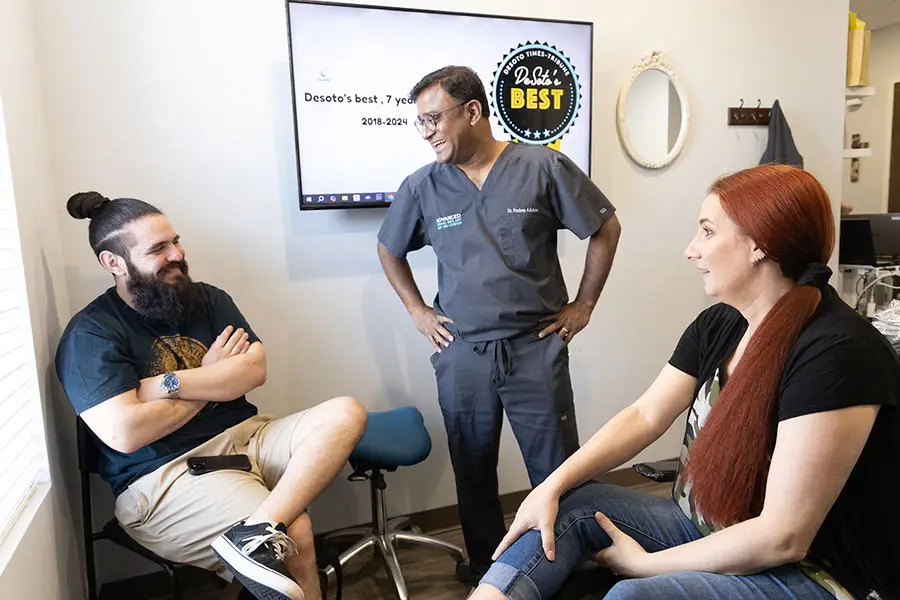
Happy Patient - Post Consultation
Why Dr. Adatrow is the Answer to Every Question Above
Dr. Pradeep Adatrow holds dual board certifications in Periodontology and Prosthodontics — two of the most rigorous specialty certifications in dentistry. He is a high-volume implant specialist with over 25 years of experience, with full-arch cases representing a core focus of practice. His center uses CBCT 3D imaging, computer-guided surgical planning, 3D-printed surgical guides, photogrammetry for full-arch cases, and in-office IV sedation as standard protocol — not premium options. Treatment plans are always itemized and presented before any commitment is made.
Patients from across the greater Memphis area - from Collierville and Germantown to Bartlett, Cordova, Arlington, Millington, Covington, and Oakland - choose his Southaven center because it answers every question above definitively.
Should I get a second opinion before proceeding with implants?
Yes - for any significant procedure, a second opinion is entirely appropriate and any reputable specialist will encourage it. Bring your CBCT scan (if you have one) to the second consultation. Compare the treatment plans, the proposed approaches, the technology each practice uses, and - critically - the credentials of each provider. The best provider will welcome scrutiny.
Is a periodontist or prosthodontist better for implants?
Both bring specialized expertise - periodontists in the surgical placement and bone management; prosthodontists in the restorative design and prosthetics. Ideally, you want both skill sets present in your treatment. A dual-certified provider brings both. If you use two specialists, communication and coordination between them is critical.
Provider Checklist
- Board certified (Perio and/or Prostho)
- High implant case volume
- CBCT 3D imaging used
- Surgical guides standard
- Photogrammetry for full-arch
- IV sedation in-office
- Itemized cost transparency
- In-house full workflow
Meet Dr. Adatrow
Dual board-certified. 25+ years experience. All technology in-house. Complimentary consultation.
Ask Every Question. We Have Every Answer.
Complimentary consultations for all Memphis area patients - Collierville, Germantown, Bartlett, Cordova, Arlington & beyond. No pressure, no commitment.