Photogrammetry & 3D Printing -Why They Are Non-Negotiable for Full-Arch Cases
<50μm
Same Day
3D
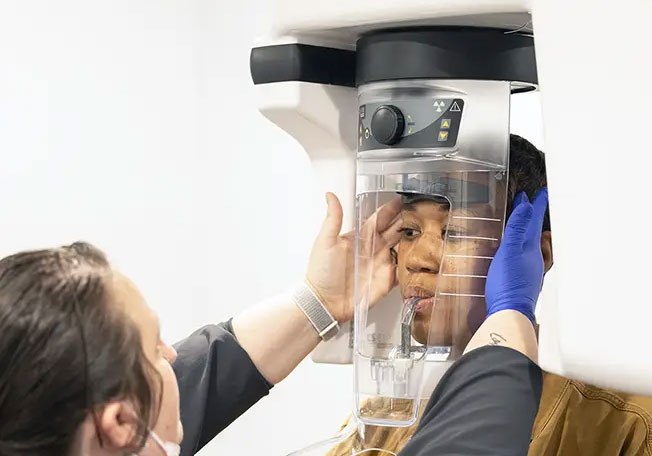
CBCT Scanner - In Practice
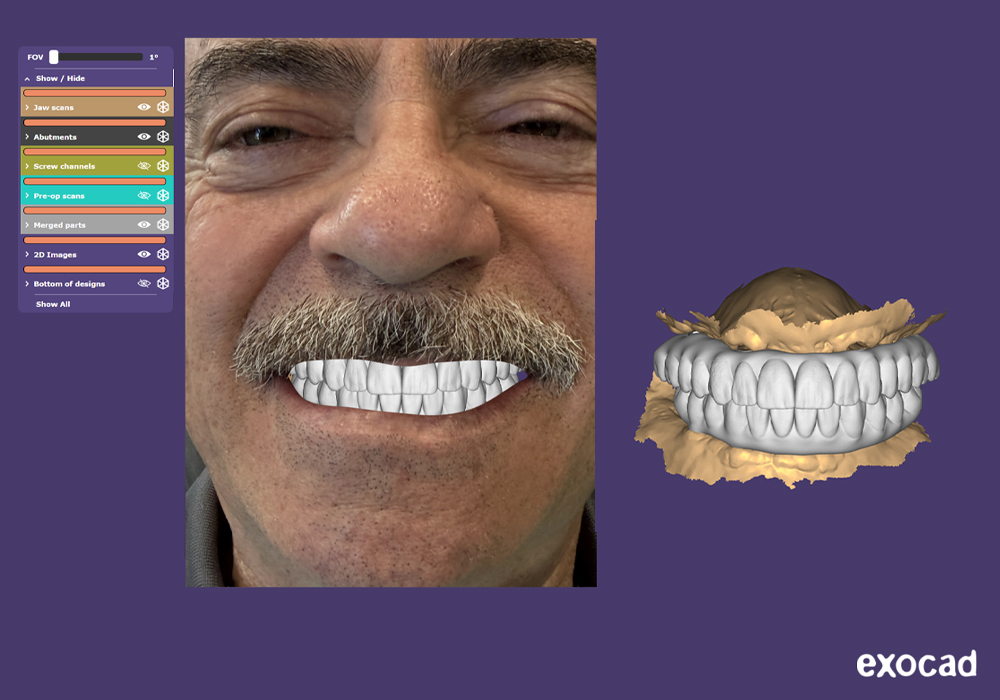
Virtual Treatment Planning Software
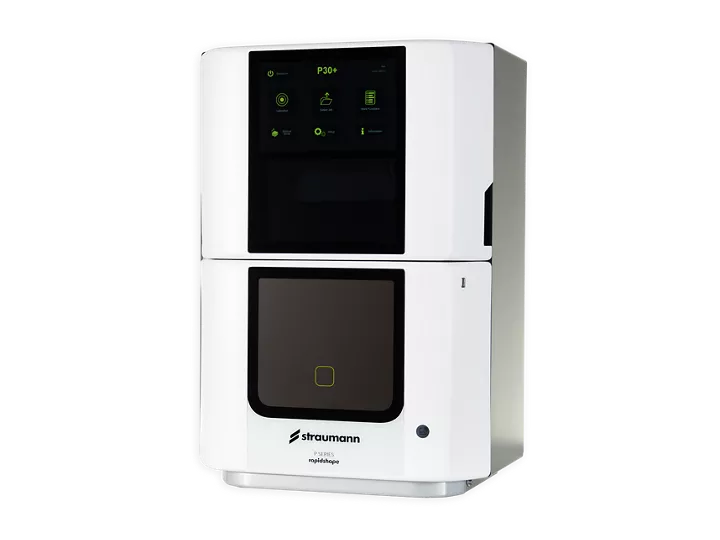
In-Office 3D Printer
Why Traditional Methods Fall Short for Full-Arch Cases
In a full-arch case like All-on-4, the final bridge - a complete set of 12–14 teeth - must seat onto 4 to 6 implants simultaneously with near-zero tolerance for error. Implants, once integrated with bone, cannot be repositioned. If the bridge doesn't fit passively, the forces distributed across the implants create cumulative stress that leads to screw loosening, component fracture, and eventually bone loss.
Traditional dental impressions - the "tray full of goop" technique - introduce compressibility errors and distortion that worsen proportionally with span length. For a single crown, a conventional impression is fine. For a bridge spanning an entire jaw, the accumulated dimensional error becomes clinically significant and often leads to a prosthesis that doesn't truly fit.
Two technologies solve this problem: photogrammetry captures implant positions with engineering-grade accuracy, and in-office 3D printing translates digital plans into physical reality - same day, at chairside.
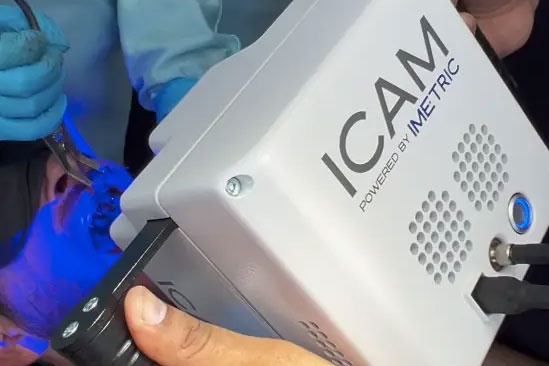
Photogrammetry Camera System
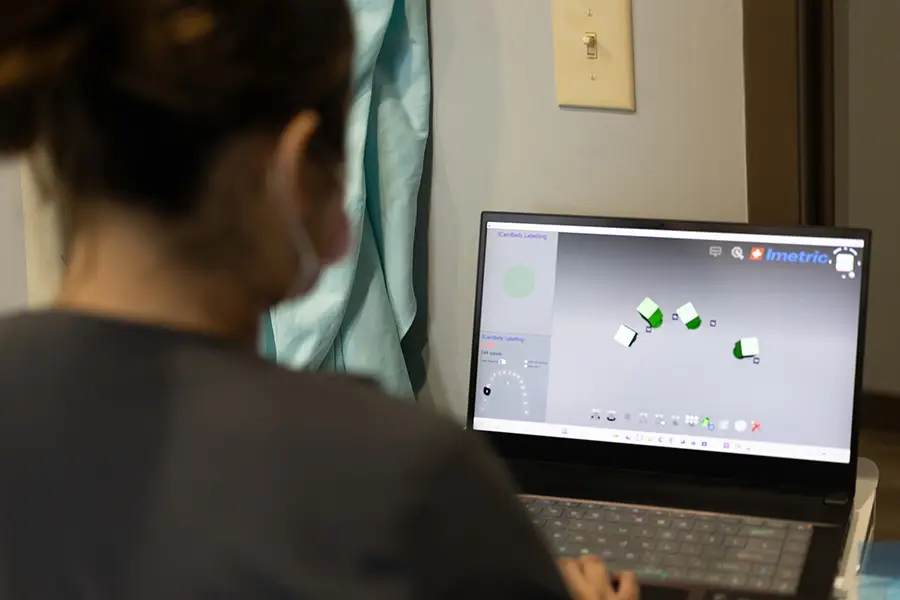
Photogrammetry Scan Readout / Software
Photogrammetry -Sub-Millimeter Implant Position Capture
Photogrammetry is a measurement science adapted from aerospace and industrial engineering that has revolutionized implant prosthodontics. Here's the core problem it solves: after implants are placed in bone at varying angles and depths, the final bridge must fit all of them simultaneously. Capturing the exact three-dimensional coordinate of each implant — its position, depth, and angulation relative to every other implant — is the most critical measurement in full-arch dentistry.
How it works: Coded scan bodies are attached to each implant. A specialized photogrammetry camera system photographs the scan bodies from multiple angles. Software triangulates the precise 3D coordinates of every implant position with accuracy under 50 microns — less than the width of a human hair. This data is transmitted digitally to the lab, where the bridge framework is milled to those exact specifications.
The result is a prosthesis that seats passively on the first try - no stress, no rocking, no adjustments needed. Zero stress at baseline means zero cumulative damage to implants over years of function.
Why Passive Fit Is So Critical
A bridge that doesn't fit perfectly doesn't just "feel off." Even a 0.1mm gap or misfit across a full arch creates measurable stress on implants every time the patient bites or chews. Multiply that by thousands of chewing cycles per day, over years, and the mechanical consequence is compounding. Screws loosen. Frameworks fatigue. Bone around implants begins to resorb from the constant micro-stress.
Photogrammetry eliminates this risk at the source. A passively fitting bridge is the most important factor in the long-term biological health of full-arch implants — and conventional impression methods cannot reliably achieve it at the precision levels photogrammetry delivers.
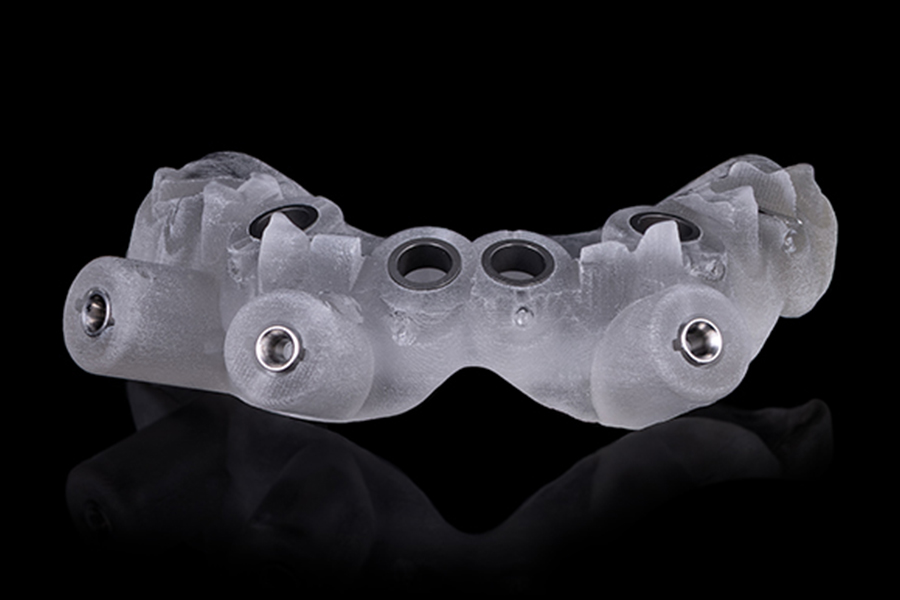
Surgical Guide
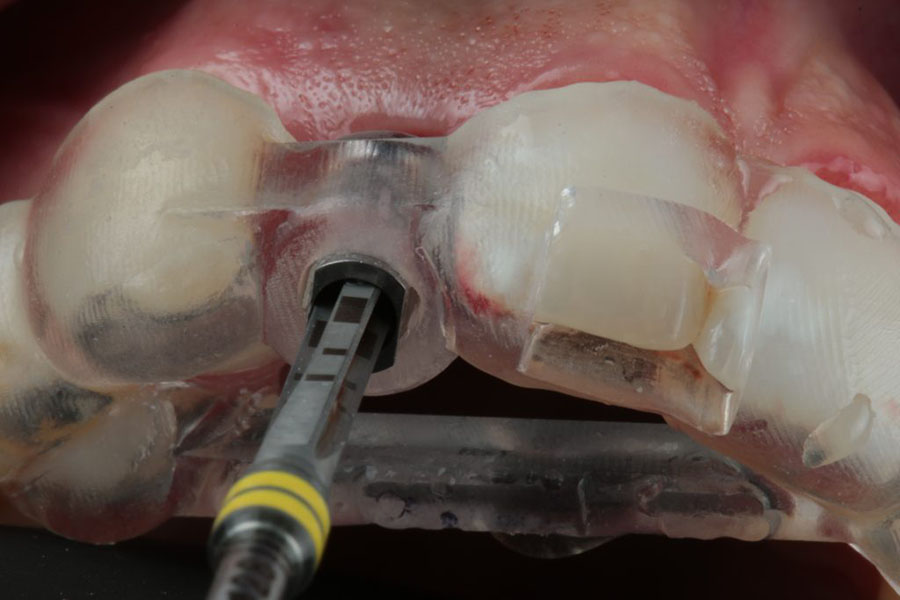
Surgical Guide - Seated In Mouth
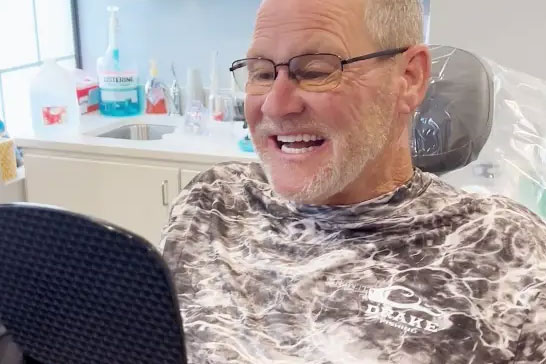
Same-Day Provisional - Patient Smiling
In-Office 3D Printing -From Digital Plan to Physical Reality, Same Day
3D printing — additive manufacturing — has transformed the speed and precision of implant dentistry. Objects that once required weeks at an external dental lab can now be produced in hours, at chairside, on the day of the patient's appointment.
Surgical Guides: The most important single application. A surgical guide is a custom-fabricated stent — designed using the patient's 3D CBCT scan and virtual implant plan — that fits over the teeth or gums and contains precisely angled channels that physically constrain the drill to the planned implant position. The difference between freehand surgery (even by an experienced surgeon) and computer-guided surgery is the difference between aiming and knowing. Surgical guides eliminate positional error.
Same-Day Provisional Restorations: For All-on-4 cases, provisional bridges are designed digitally before surgery begins and printed in advance. Immediately after implant placement, the provisional is individualized and seated. The patient leaves with functional, aesthetic teeth the same day as surgery — the hallmark of the All-on-4 experience.
Additional Applications: Diagnostic wax-ups for smile previews before any treatment begins; custom healing abutments that shape gum tissue into ideal emergence profiles; verification jigs that confirm passive fit of the final framework before delivery.
The Full Digital Workflow at Dr. Adatrow's Center
The integration of CBCT scanning, virtual planning software, 3D-printed surgical guides, photogrammetry, and digital prosthetics fabrication creates a seamless workflow where every component informs the next. The patient's anatomy exists as a precise 3D dataset. Every surgical decision is planned against that dataset. Every prosthetic component is fabricated to its specifications. The result is a closed-loop system where error has no opportunity to accumulate.
This is not futuristic technology — it is the current standard of care for full-arch implant dentistry. Patients from across the Memphis area - Germantown, Collierville, Bartlett, Cordova, Arlington, Millington, and beyond - deserve access to this level of precision without traveling to a major metropolitan center. Dr. Adatrow's Southaven center brings it to the Mid-South.

Both Technologies Are Standard Protocol — Not Optional Add-Ons
At Advanced Dental Implant and TMJ Center, photogrammetry and in-office 3D printing are used as standard protocol for all full-arch implant cases. They are not premium options. They are the minimum standard Dr. Adatrow applies to every patient who trusts him with a complete smile reconstruction.
Do all implant providers use photogrammetry?
No. Photogrammetry requires specialized equipment and training, and many providers still rely on conventional impressions or intraoral scanners for full-arch cases. When evaluating providers for All-on-4 or full-arch reconstruction, specifically ask: "Do you use photogrammetry for your full-arch cases?" If the answer is no, ask what method they use to verify passive fit — and assess that answer carefully.
How does a surgical guide improve outcomes?
A surgical guide physically directs the drill to the pre-planned position, depth, and angulation — eliminating the variability of freehand placement. Studies show guided surgery reduces implant positioning deviation by 50–80% compared to freehand technique. In a full-arch case where the bridge is pre-designed to fit those specific positions, guide accuracy is directly linked to prosthetic fit quality.
Does having these technologies mean the surgery is longer?
No - it typically means surgery is shorter. A surgical guide allows the surgeon to work efficiently and precisely without repeated repositioning or verification steps. Shorter surgery time also reduces anesthesia exposure, post-operative inflammation, and recovery duration.
Technologies Used
- CBCT 3D imaging (pre-surgery)
- Virtual implant planning software
- 3D-printed surgical guides
- Photogrammetry (post-placement)
- Digital prosthetics fabrication
- Same-day provisional printing
See the Technology in Action
Related Pages
- All-on-4 Full Arch
- Choosing a Provider