Understanding Dental Implant Costs in the Memphis Area
Implant dentistry involves more variables than most patients realize - and more opportunities to make a well-informed financial decision. This guide covers what drives costs, what realistic ranges look like in the Memphis market, and how to evaluate financing and insurance options.
$3.5K
Single Implant Starting
$20K+
All-on-4 Starting
0%
Financing Available
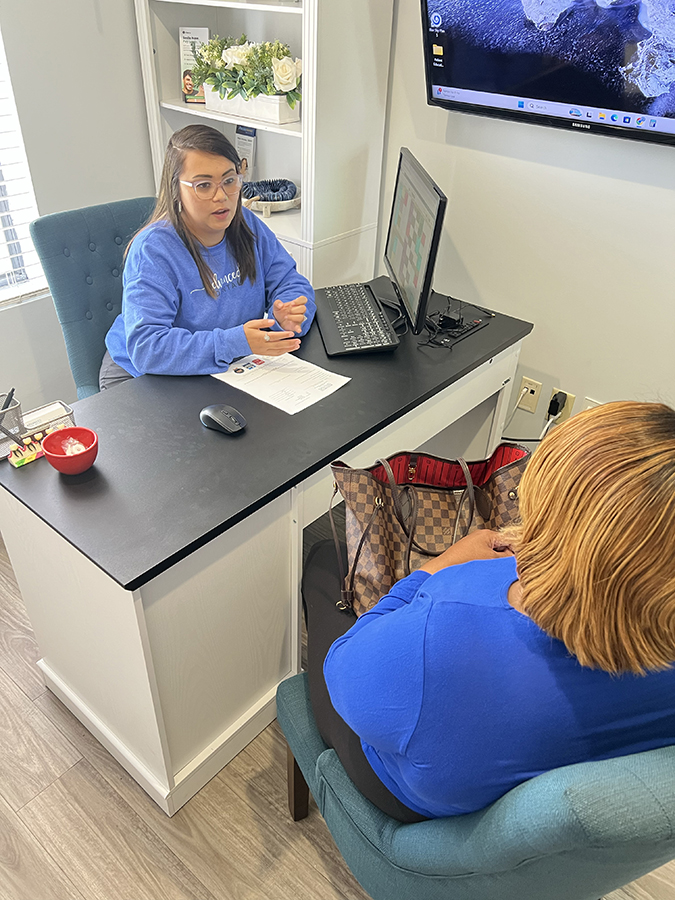
Treatment Plan Review

Patient Financing Discussion
Why Implant Costs Vary -What You're Actually Paying For
A dental implant is not a single item with a fixed price tag. It is a multi-component restoration that involves surgical planning, imaging technology, the implant hardware itself, the abutment, the final crown or prosthesis, and the specialist expertise to coordinate all of it. Understanding each component helps you evaluate any treatment plan you receive — and ask the right questions.
Component 1: Consultation & 3D Imaging (CBCT Scan)
Before any implant is placed, your bone anatomy must be mapped in three dimensions. A cone-beam CT (CBCT) scan is the non-negotiable standard of care. This scan reveals bone density and volume at every potential implant site, maps nerve locations, sinus anatomy, and identifies any pathology. Without it, treatment planning is guesswork. At Advanced Dental Implant & TMJ Center, the consultation including 3D imaging is complimentary for new implant patients.
Complimentary
Component 2: Extractions (If Needed)
If failing teeth must be removed before implants are placed, the extraction cost is typically separate. Simple extractions are significantly less expensive than surgical extractions of impacted or broken-down roots.
$150 – $350
$250 – $600
$1,500 – $4,000
Component 3: Bone Grafting (If Needed)
Bone grafting is required when insufficient bone volume exists for stable implant placement. The type and extent of grafting needed – from a small socket preservation graft to a major sinus lift – significantly affects cost. PRF/PRP biologics, which accelerate healing and improve graft outcomes, are incorporated as standard practice at our center.
$400 – $900
Socket Preservation (per site)
$1,500 – $3,500
Ridge Augmentation (per site)
$2,000 – $5,000
Sinus Lift (per side)
Included in graft fee
PRF/PRP Enhancement
Component 4: The Implant Post Itself
The titanium implant post — the part that goes into bone — is priced per implant. High-quality implants from established manufacturers (Nobel Biocare, Straumann, Zimmer Biomet) cost more than lesser-known brands, but the difference in reliability, long-term performance, and restorative compatibility is meaningful. Dr. Adatrow uses only established, evidence-backed implant systems.
$1,500 – $2,800
Implant Post Placement (per implant)
Component 5: The Abutment & Final Restoration
The abutment connects the implant to the crown. The crown itself – the visible tooth – adds its own cost based on material (zirconia vs. ceramic vs. porcelain-fused-to-metal) and fabrication method. For full-arch cases, the prosthesis (the bridge of all teeth) is a significant fabrication cost reflecting the material, precision, and lab work required.
$1,500 – $2,500
Abutment + Single Crown
$3,500 – $5,500
Implant Bridge (3-unit)
$2,500 – $5,000
Full-Arch Provisional (temporary)
$8,000 – $15,000
Full-Arch Final Zirconia Bridge
Component 6: Sedation
IV sedation is recommended for complex procedures and priced based on duration. In-office IV sedation at our center is significantly less expensive than hospital-based anesthesia — which can add $2,000–$5,000 when required at a surgical center or hospital.
$50 – $150
Nitrous Oxide (per visit)
$150 – $400
Oral Sedation
$500 – $1,500
IV Sedation (in-office)
All-In Cost Ranges by Procedure – Memphis Area
The ranges below represent realistic all-in estimates for each procedure type – including implants, abutments, crowns, and typical associated costs – in the greater Memphis, Tennessee market. Individual cases vary based on bone quality, extractions needed, sedation, and materials selected.
Complete Procedure Cost Ranges
$3,500 – $6,000
Single Tooth Implant (no graft needed)
$4,500 – $9,000
Single Tooth Implant (with bone graft)
$6,000 – $12,000
Implant-Supported Bridge (3-unit)
$5,000 – $10,000
Snap-On Implant Denture (2 implants)
$10,000 – $18,000
Snap-On Implant Denture (4 implants)
$20,000 – $30,000
All-on-4 Single Arch
$25,000 – $38,000
All-on-6 / All-on-X Single Arch
$40,000 – $65,000
Full Mouth Reconstruction (both arches)
What Drives Cost Differences Between Providers
Patients frequently ask why implant prices vary so dramatically — sometimes by $5,000–$15,000 for what sounds like the same procedure. The differences are real and meaningful. Understanding them protects you from making a decision based on price alone.
Specialist Training vs. General Dentist
Board-certified periodontists and prosthodontists complete 3–4 additional years of specialty residency after dental school. Their fees reflect that expertise. A general dentist offering implants at a lower price point has undergone continuing education courses — typically measured in days, not years — that cannot replicate the depth of specialty training. For complex cases, this difference in training has direct clinical consequences.
Technology Used
3D CBCT imaging, computer-guided surgical planning, 3D-printed surgical guides, and photogrammetry for full-arch fit verification all add cost to a practice — and they add value to your outcome. A provider charging significantly less may be using conventional impressions, freehand surgery, or outsourcing lab work to lower-cost fabricators. These choices affect fit accuracy, long-term success rates, and ultimately the longevity of your investment.
Implant Brand & Prosthetic Material
Nobel Biocare and Straumann implants carry premium pricing — and premium long-term documentation. The final prosthesis material matters equally: a monolithic zirconia bridge lasts significantly longer than an acrylic provisional or resin hybrid, and costs more to fabricate. The implant and prosthesis you choose are a multi-decade investment; cutting corners on materials is rarely wise economics.
The True Cost of Implant Failure
A failed implant — requiring removal, bone regeneration, healing, and re-placement — typically costs as much as the original procedure, sometimes more. The real cost of choosing the least expensive option is not the upfront savings but the potential expense and disruption of correction. An implant placed and restored correctly by an experienced specialist should last decades without intervention.
Insurance and Coverage
Dental insurance historically provides very limited coverage for implants, though the landscape is improving as implants become the recognized standard of care. Understanding your specific plan is essential.
What Dental Insurance Typically Covers
- Extractions: usually covered as a basic procedure (50–80%)
- Some bone grafting: sometimes covered as a surgical benefit
- The crown portion of a single implant: sometimes covered as a major restorative service (50%)
- The implant post itself: often NOT covered as a surgical benefit under most plans
Medical Insurance — An Overlooked Option
Medical insurance may cover implant-related care when tooth loss or jaw surgery is connected to a covered medical condition — trauma, oral cancer treatment, radiation therapy, certain systemic diseases, or documented functional impairment. This is especially worth exploring for patients losing teeth due to medical treatments or conditions. Contact your medical insurance carrier directly and ask about coverage for “osseointegrated implants related to [your diagnosis].”
Flexible Spending & Health Savings Accounts (FSA / HSA)
Implant procedures are eligible expenses under both FSA and HSA accounts. If you have either, coordinate your treatment timeline to maximize your annual contributions. Using pre-tax dollars effectively reduces the real cost of your implant investment by your marginal tax rate — often 20–35%.
Financing Options
High-quality implant care should be accessible. Our center works with financing partners to make monthly payment plans available for all qualifying patients — often with promotional 0% interest periods.
Financing Available
Why the Upfront Cost Is the Right Framework
Conventional dentures may cost $1,500–$4,000 — but require relining or replacement every 5–8 years, denture adhesive products indefinitely, and do not prevent the ongoing bone loss that progressively makes your anatomy worse and future implant treatment more expensive. A $3,500 single-tooth implant placed today, maintained properly, may last your lifetime without further intervention. The relevant comparison is not implant cost vs. denture cost today — it is implant cost vs. cumulative alternative cost over 20–30 years.

Full Cost Transparency at Every Consultation
At Advanced Dental Implant & TMJ Center, every consultation includes a fully itemized treatment plan — with every cost spelled out — before you make any commitment. There are no hidden fees, no bait-and-switch pricing, and no pressure to decide on the day of your consultation. Serving all of greater Memphis, TN from Southaven, MS.
Why is All-on-4 so expensive?
All-on-4 involves 4–6 implant placements, full-arch extractions in most cases, IV sedation, a 3D-guided surgical workflow, a provisional bridge placed the same day, and a final zirconia or hybrid bridge fabricated with photogrammetric accuracy. Each of these components has real cost. The procedure also involves the highest level of surgical and prosthetic skill in implant dentistry. Practices that quote All-on-4 well below market rates may be using lower-quality materials, less technology, or lesser-trained providers — all of which affect long-term outcomes for what is a permanent, life-altering restoration.
Is a payment plan available?
Yes. We work with CareCredit and other patient financing programs to offer monthly payment options for qualifying patients. Promotional 0% interest periods are available for eligible procedures. Our patient care coordinator will present financing options at your consultation with full details. There is no pressure and no commitment required to receive this information.
Will my dental insurance help at all?
It depends on your specific plan. We recommend calling the member services number on your insurance card and asking specifically: "Does my plan cover dental implants? Does it cover the implant crown? Does it cover bone grafting?" Get answers in writing if possible. Our patient care team will also assist with a benefits review at your consultation. Even partial insurance coverage can meaningfully reduce your out-of-pocket expense.
Is cheaper always worse for implants?
Not categorically — but it warrants investigation. Ask exactly what is and is not included in any quoted price. Ask about implant brand, crown material, sedation options, and whether the quoted provider is board-certified. Price differences often reflect real differences in materials, technology, and training. For a restoration you intend to live with for decades, the cost of quality is almost always less than the cost of correction.
Cost Ranges at a Glance
- Single implant: $3.5K–$9K
- Implant bridge: $6K–$12K
- Snap-on denture: $5K–$18K
- All-on-4 (1 arch): $20K–$30K
- Both arches: $40K–$65K
- Sinus lift: add $2K–$5K
- Bone graft: add $400–$3.5K
Ways to Pay
- CareCredit 0% financing
- FSA / HSA pre-tax dollars
- Medical insurance (for trauma/cancer)
- Dental insurance (partial)
- Cash / check / major credit cards
Free Cost Consultation
Every consultation includes a fully itemized treatment plan. No commitment, no pressure — just complete information.